
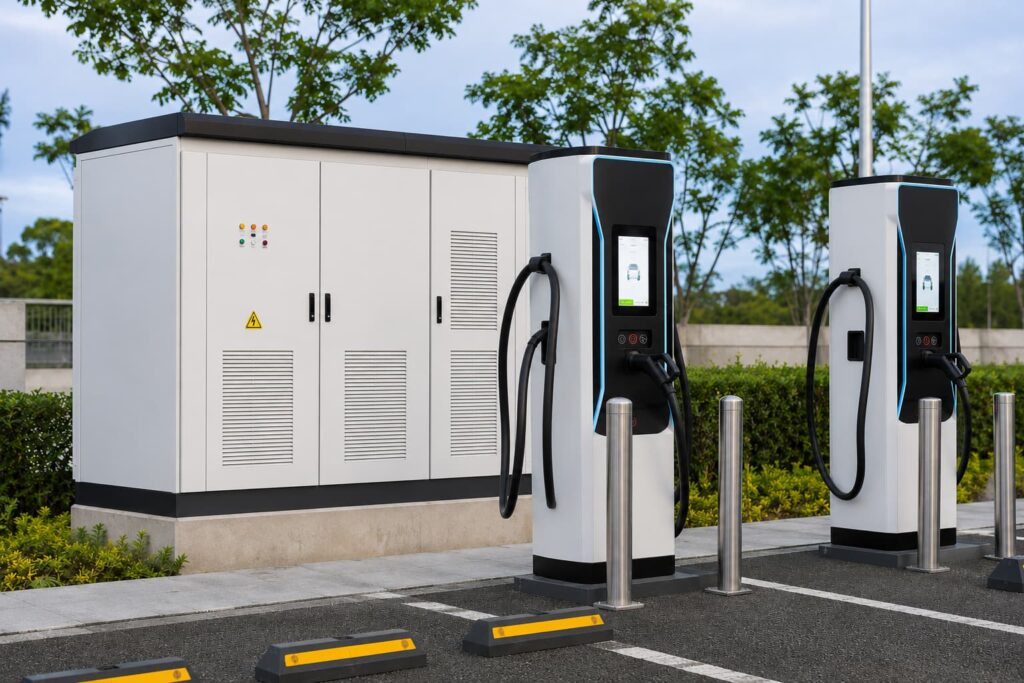
As electric vehicles become more common worldwide, the demand for faster and more efficient charging infrastructure continues to grow. Traditional integrated DC chargers are still widely used, but many commercial charging operators are now choosing split DC chargers for large-scale charging stations, fleet operations, and highway service areas.
But what exactly is a split DC charger, and how does it work?
In simple terms, a split DC charger separates the power conversion system from the charging terminals. Instead of placing all components inside one charger cabinet, the system uses a centralized power cabinet connected to multiple charging dispensers. This design offers higher flexibility, better power utilization, and easier expansion for commercial EV charging projects.
We will explain how split DC chargers work, their key components, advantages, and why they are becoming increasingly popular in modern EV charging infrastructure.
What Is a Split DC Charger?
A split DC charger, also called a split-type DC fast charger, is an EV charging system where the main power modules are installed in a central power cabinet, while the user-facing charging terminals are separated into independent dispensers.
Unlike traditional integrated DC chargers, where all components are built into one cabinet, split charging systems divide the charging architecture into two main sections:
- Centralized power cabinet
- Charging dispensers
The power cabinet converts AC electricity from the grid into DC electricity and distributes power to multiple dispensers connected throughout the charging station.
This structure allows one power system to serve several charging points simultaneously, making it highly suitable for commercial and high-traffic charging applications.
Main Components of a Split DC Charging System
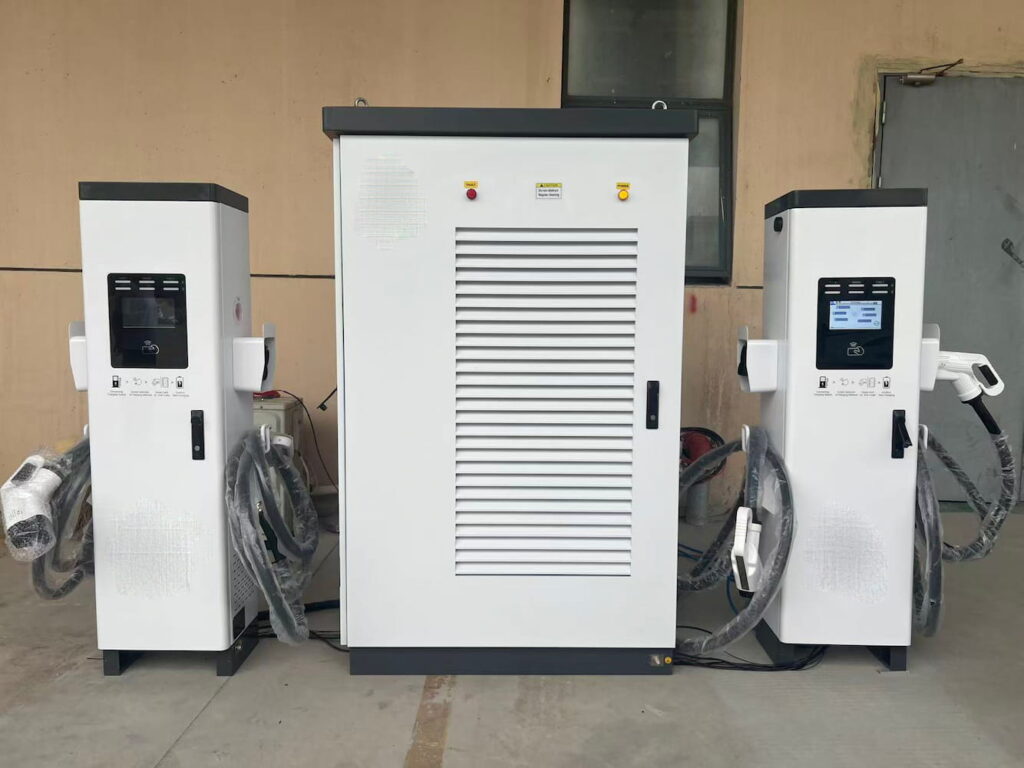
To better understand how a split DC charger works, it is important to first understand its main components.
Power Cabinet
The power cabinet is the core of the entire charging system. It usually contains:
- Power modules
- Rectifiers
- Cooling systems
- Power distribution units
- Central control systems
Its main function is converting AC power from the electrical grid into stable DC power suitable for EV battery charging.
The power cabinet is normally installed in a technical area away from vehicle parking spaces. Since the cabinet handles all power conversion tasks, the charging dispensers can remain smaller and more compact.
For high-power charging stations, the power cabinet may support power capacities such as:
- 240kW
- 360kW
- 480kW
- 600kW or higher
Charging Dispenser
The charging dispenser is the visible terminal used by EV drivers.
It usually includes:
- Charging cable
- Connector
- Touchscreen or display
- RFID or payment system
- Emergency stop button
- Communication interface
Unlike integrated chargers, the dispenser itself does not contain large power modules. It mainly acts as the interface between the vehicle and the centralized power cabinet.
Because of this design, dispensers are slimmer, lighter, and easier to install in parking areas.
Intelligent Power Distribution System
One of the most important features of split DC chargers is intelligent power allocation.
The system can dynamically distribute available power among multiple charging dispensers depending on vehicle demand.
For example:
- Vehicle A may only require 60kW
- Vehicle B may require 180kW
The system automatically allocates more available power to the vehicle with higher charging demand. This improves overall charging efficiency and increases power utilization.
How Does a Split DC Charger Work?
The working principle of a split DC charger can be explained in several simple steps.
Step 1: AC Power Enters the Power Cabinet
Electricity from the utility grid enters the centralized power cabinet as alternating current (AC).
The incoming power may vary depending on local electrical infrastructure, but commercial charging stations commonly use three-phase AC power.
Step 2: AC Power Converts to DC Power
Inside the power cabinet, rectifier modules convert AC electricity into direct current (DC).
This conversion process is critical because EV batteries can only store DC power.
The power modules continuously regulate voltage and current to ensure stable and safe charging performance.
Step 3: The System Allocates Power to Different Dispensers
After power conversion, the system intelligently distributes DC power to connected charging dispensers.
Unlike traditional chargers with fixed power output, split DC chargers can share power dynamically.
For example, if only one vehicle is charging, the system may allocate nearly all available power to that vehicle. When more vehicles connect, the system automatically balances the power among them.
This flexibility greatly improves charging station efficiency.
Step 4: Communication With the Vehicle Begins
Once the EV is plugged in, the charger communicates with the vehicle’s Battery Management System (BMS).
The BMS exchanges important information with the charger, including:
- Battery voltage
- Charging current demand
- Battery temperature
- Charging status
- Safety conditions
Based on this information, the charging system continuously adjusts charging parameters in real time.
Step 5: Dynamic Charging Adjustment
During the charging process, the system constantly monitors battery conditions and charging demand.
As the battery approaches higher state-of-charge levels, the charger gradually reduces charging current to protect battery health and maintain safe operation.
This intelligent charging management helps optimize charging speed while ensuring long-term battery reliability.
Advantages of Split DC Chargers
Split DC charging systems offer several important advantages compared with traditional integrated chargers.
Flexible Power Sharing
One centralized power cabinet can support multiple charging dispensers.
This allows charging stations to distribute power more efficiently and reduce energy waste.
Higher Space Efficiency
Because dispensers are smaller and lighter, charging stations can optimize parking layouts more easily.
This is especially useful for:
- Highway charging stations
- Fleet depots
- Commercial parking areas
- Bus charging stations
Easier Future Expansion
One major advantage of split systems is scalability.
Operators can install additional charging dispensers later without replacing the entire power system.
This reduces future expansion costs and provides greater flexibility as EV demand increases.
Better Equipment Utilization
Traditional integrated chargers often leave unused power capacity when charging demand is low.
Split DC chargers improve utilization by dynamically distributing power where it is needed most.
This helps maximize charging station efficiency and return on investment.
Easier Maintenance
Since the power modules are centralized inside one cabinet, maintenance becomes simpler.
Technicians can service the power cabinet without interrupting all charging dispensers, helping reduce downtime.
Split DC Charger vs Integrated DC Charger
Although both systems provide DC fast charging, their structures are quite different.
Integrated DC chargers place all components inside one cabinet, including:
- Power modules
- Cooling systems
- User interface
- Charging cable
This design works well for smaller charging sites.
However, for large commercial charging stations, split DC chargers offer greater flexibility and scalability.
Integrated chargers are usually easier to install initially, but split systems perform better in high-traffic charging environments where multiple vehicles require simultaneous charging.
Where Are Split DC Chargers Commonly Used?
Split DC charging systems are becoming increasingly popular in many commercial applications.
Common installation locations include:
- Highway service stations
- Public EV charging hubs
- Commercial parking facilities
- Electric bus depots
- Truck charging stations
- Fleet charging centers
As ultra-fast charging demand continues to increase, more operators are choosing split charging architecture for future-ready infrastructure.
Future Trends of Split DC Charging
The EV industry is moving toward higher charging power and smarter energy management.
Split DC charging systems are well positioned for these future trends because they support:
- Ultra-fast charging
- Dynamic load balancing
- Smart energy management
- Renewable energy integration
- Energy storage systems
- Megawatt charging technology
In the future, split charging systems are expected to play an even more important role in large-scale EV charging infrastructure worldwide.
Conclusion
Split DC chargers are becoming an important solution for modern commercial EV charging stations. By separating the centralized power cabinet from charging dispensers, these systems provide greater flexibility, higher efficiency, and easier scalability compared with traditional integrated chargers.
Their intelligent power distribution capability allows multiple vehicles to share available charging power dynamically, helping operators improve utilization and reduce operational costs.
As EV adoption continues to grow rapidly, split DC charging systems will likely become a key technology for supporting high-power and large-scale charging networks in the years ahead.


