

Malaysia’s electric vehicle market is developing quickly, and the availability of reliable EV charging infrastructure is becoming increasingly important for EV owners, property developers, businesses, and fleet operators.
With more charging stations being installed across highways, shopping malls, condominiums, hotels, offices, and commercial properties, Malaysia now has several major EV charging companies competing to build larger and smarter charging networks.
But which is the best EV charger company in Malaysia?
There is no single answer. The best company depends on what you need — nationwide public charging, highway fast charging, home EV charging, commercial charging, or a complete charging solution for a business.
In this guide, we compare some of the leading EV charging companies in Malaysia and explain the advantages of each.
Malaysia's Leading EV Charging Companies at a Glance
| Company | Main Brand / Network | Main Strength | Best For |
|---|---|---|---|
|
ChargeSini |
ChargeSini |
Large nationwide network and urban coverage |
City charging, condos, malls |
|
EV Connection |
JomCharge |
Highway and nationwide charging |
Long-distance EV travel |
|
Yinson GreenTech |
chargEV |
Established network and commercial partnerships |
Malls, hotels, offices and public charging |
|
TNB |
TNB Electron |
Electricity infrastructure and growing DC network |
cities and strategic locations |
|
Charge N Go |
Charge N Go |
Rapid network expansion and destination charging |
Commercial and residential properties |
The companies above are not identical competitors. Some focus heavily on public charging networks, while others provide installation, charging hardware, software, and commercial solutions.
1. ChargeSini — One of Malaysia's Largest EV Charging Networks
ChargeSini is one of the most prominent local EV charging operators in Malaysia.
According to 2025 industry data, ChargeSini reached 1,110 charging points, making it the largest CPO in the country by reported charging-point count at that time. The network added 376 points in one year, representing approximately 51% growth.
ChargeSini provides both AC and DC charging and has expanded its presence across shopping malls, commercial properties, condominiums, and other urban locations.
Key Advantages of ChargeSini
1. Large charging network
Its extensive network is one of its biggest advantages. ChargeSini’s own network page currently lists hundreds of locations and more than 1,000 chargers/ports.
2. Strong urban presence
ChargeSini is particularly suitable for EV drivers who charge at shopping malls, condominiums, offices, and other destination locations.
3. Smart charging platform
The ChargeSini app allows users to locate chargers, check real-time availability, reserve charging slots, start charging, and make payments.
4. Business-oriented solutions
ChargeSini also provides charging solutions for property owners and businesses. Its portfolio includes AC chargers and DC chargers, while its business model allows property owners to participate in the growing EV charging market.
2. JomCharge by EV Connection — A Strong Choice for Highway Charging
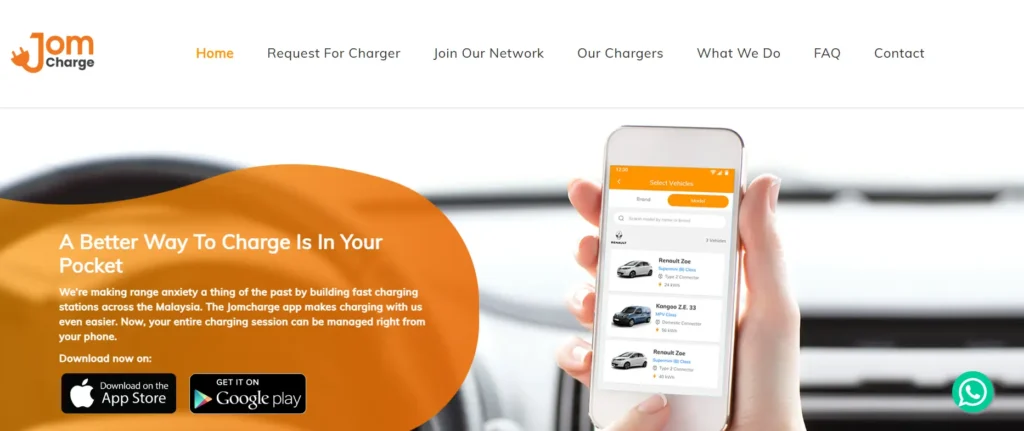
EV Connection operates the JomCharge charging network and is one of Malaysia’s best-known EV charging infrastructure companies.
JomCharge reached approximately 680 charging points in 2025, up from 476 in 2024. This made it the second-largest network in the cited 2025 CPO ranking.
The company provides EV charging hardware, installation, charging-network operation, solar solutions, battery energy storage and other EV-related services.
Key Advantages of JomCharge
1. Strong highway coverage
JomCharge is particularly well known for supporting interstate EV travel, including charging locations along Malaysia’s major highway network.
2. Large CCS2 fast-charging footprint
Its network has become an important part of Malaysia’s DC fast-charging infrastructure.
3. Easy-to-use mobile platform
The JomCharge app allows drivers to locate chargers, view charger status, start and stop charging, make payments, and monitor charging sessions.
4. Complete energy solutions
EV Connection is not simply a charging-network operator. It also offers commercial and household EV chargers, solar PV systems and battery energy storage solutions.
3. chargEV by Yinson GreenTech — An Established EV Charging Specialist
Yinson GreenTech operates chargEV, one of Malaysia’s established EV charging networks.
Yinson GreenTech says chargEV has more than a decade of experience in installing and operating EV charging networks. As of FY2026, the company reported 357 chargers operated and maintained across 209 charge sites, while facilitating access to a broader network.
In July 2026, Yinson GreenTech launched the chargEV 2.0 app following more than one million charging sessions, highlighting the company’s focus on improving its digital charging experience.
Key Advantages of chargEV
1. Long operating experience
chargEV has been active in Malaysia’s EV charging ecosystem for many years, giving it substantial experience in operating charging infrastructure.
2. Strong commercial partnerships
The company works with property developers, retailers, hotels, F&B businesses, logistics companies and infrastructure operators. Its partners include names such as Sime Darby Property, EcoWorld, Starbucks, AEON, Pos Malaysia and PLUS.
3. Malaysia-Singapore connectivity
chargEV positions itself as a cross-border charging network between Malaysia and Singapore, which can be particularly useful for drivers travelling between the two countries.
4. Continued investment
In 2025, Khazanah invested in chargEV to support further development of Malaysia’s EV charging ecosystem and expansion of charging stations nationwide.
4. Gentari — A Major Energy Player in Malaysia's EV Charging Market
Gentari is the clean-energy business associated with PETRONAS and has become a major player in Malaysia’s EV charging infrastructure.
Gentari currently states that its Gentari Go network provides access to 600+ licensed EV charging points in Malaysia, with additional chargers available through partner networks.
Key Advantages of Gentari
1. Strong highway presence
Gentari has focused heavily on strategic charging locations along highways and major travel routes.
2. Strong energy-company backing
Unlike a pure-play charging operator, Gentari operates within a broader clean-energy ecosystem. This gives it opportunities to combine EV charging with renewable energy and energy-storage solutions.
3. Large partnership network
Gentari has developed roaming partnerships that allow users to access chargers operated by other networks. Its earlier roaming agreement with JomCharge and chargEV connected users to hundreds of charging points across Malaysia.
4. Gentari Go digital platform
The Gentari Go app allows users to locate, activate and monitor charging sessions, while the company is also expanding services such as home charger installation.
5. TNB Electron — Backed by Malaysia's Electricity Utility
Tenaga Nasional Berhad, through TNB Electron, is another important participant in Malaysia’s EV charging infrastructure.
TNB has a unique advantage because it is deeply involved in Malaysia’s electricity infrastructure. In addition to installing charging points, TNB supports CPOs through its EV Green Lane initiative, designed to streamline electricity-supply connections for EV charging infrastructure.
By September 2025, TNB reported 160 TNB Electron charge points installed, with more than 250 targeted by the end of 2025.
Key Advantages of TNB Electron
1. Strong electricity infrastructure expertise
EV charging depends on reliable electrical infrastructure. TNB’s core business gives it a natural advantage in grid connection and electrical infrastructure.
2. Strategic charging locations
TNB Electron has deployed charging points across highways, urban areas, TNB facilities and other strategic locations.
3. Growing DC fast-charging network
TNB has been expanding its DC charging infrastructure to support longer-distance EV travel.
4. Strong long-term potential
As Malaysia’s electricity demand and EV adoption grow together, TNB is strategically positioned to participate in the development of the country’s charging ecosystem.
6. Charge N Go — Rapidly Expanding Charging Network
Charge N Go is another Malaysian EV charging company worth watching.
Industry data shows that Charge N Go increased its charging points from 134 in 2024 to 378 in 2025, representing growth of approximately 182%.
The company provides EV charging services and charging-infrastructure installation. Its solutions are particularly relevant to residential buildings and commercial properties.
Key Advantages of Charge N Go
1. Fast network expansion
Its rapid growth demonstrates an aggressive approach to deploying charging infrastructure.
2. Residential and condominium opportunities
Charge N Go has focused on solutions that can help EV owners in high-rise residential environments where installing a private home charger can be difficult.
3. Commercial charging services
The company can provide charging infrastructure and operational services for property owners.
4. Zero-upfront-cost possibilities
For suitable property projects, operator-led models can help property owners introduce EV charging without having to manage the entire charging operation themselves.
What Should Businesses Consider When Choosing an EV Charger Company?
For businesses, the cheapest charger is not necessarily the best charger.
Before choosing an EV charging partner, consider the following factors.
1. Charger Power
For home and destination charging, 7 kW, 11 kW and 22 kW AC chargers are common choices.
For highway and public fast charging, DC chargers from 30 kW to 180 kW or higher may be more suitable.
2. Connector Compatibility
The charger should support the connectors used by the target EV market.
For Malaysia, Type 2 and CCS2 are particularly important for many modern EVs.
3. Network Management
For commercial charging, look for features such as:
- Real-time monitoring
- Remote charger management
- RFID authentication
- QR-code payment
- Mobile app
- Dynamic pricing
- User management
- Charging-session records
- OCPP compatibility
4. Installation and Electrical Infrastructure
The charger itself is only part of the project.
Businesses should also evaluate:
- Available electrical capacity
- Cable size
- Protection devices
- Distribution board capacity
- Earthing
- Load management
- Transformer requirements
- Civil works
- Installation and commissioning
5. After-Sales Support
Public EV chargers operate for long hours and may be exposed to Malaysia’s hot, humid and rainy environment.
A reliable supplier should provide:
- Warranty
- Spare parts
- Remote technical support
- On-site maintenance
- Software support
- Fault diagnosis
- Firmware updates
6. Business Model
Property owners should also decide whether they want to:
Buy and operate the chargers themselves
or
Work with a CPO/operator that manages the charging network.
The second model can reduce the technical and operational burden for property owners.
The Future of EV Charging in Malaysia
Malaysia’s EV charging market is becoming increasingly competitive.
The leading companies are no longer competing only on the number of chargers. They are also competing on charging speed, network coverage, software, payment convenience, interoperability, reliability and commercial partnerships.
The country’s leading CPOs collectively expanded their infrastructure significantly during 2025, with the top 10 operators reaching 3,894 charging points and growing their combined infrastructure by 55.8% year over year.
Another important development is roaming and network interoperability. In 2025, chargEV, JomCharge, DC Handal and CarputZAP formed the eRoaming Hub Alliance, with the goal of creating a more seamless charging experience across different networks.
This means Malaysian EV drivers may increasingly care less about which company owns a particular charger and more about whether they can easily find, access and pay for the charger through their preferred platform.
Conclusion: Which EV Charging Company Should You Choose?
Malaysia has a growing number of capable EV charging companies, and each has a different competitive advantage.
ChargeSini stands out for network scale and urban coverage.
JomCharge is particularly strong for highway and nationwide charging.
chargEV benefits from long operating experience and strong commercial partnerships.
Gentari combines EV charging with a broader clean-energy ecosystem.
TNB Electron has the advantage of deep electricity-infrastructure expertise.
Charge N Go is an interesting choice for rapidly expanding residential and commercial charging projects.
For EV drivers, the best network is usually the one with reliable chargers in the places you actually drive.
For businesses, however, the decision is more complex. The right EV charging partner should provide not only charging hardware, but also installation, software, payment, maintenance, load management and long-term technical support.
As EV adoption continues to grow in Malaysia, the companies that can combine reliable hardware with smart software, strong infrastructure and flexible business models will be best positioned to lead the next stage of the EV charging market.


